Academic journal articles are an important part of university learning, scientific research, and academic writing. They provide evidence, explain new discoveries, evaluate existing ideas, and help students understand what researchers already know about a subject. However, reading them can feel challenging, especially when they contain technical terminology, statistical results, complex arguments, and unfamiliar research methods.
Learning how to read academic journal articles is a skill that becomes easier with practice. Instead of reading every paper from beginning to end at the same speed, you can use a structured approach to identify the main argument, understand the research methods, evaluate the evidence, and record the information that matters to your studies.
This guide explains how academic journal articles are organized, how to read them efficiently, how to understand difficult sections, and how to decide whether a study is reliable and relevant to your research.
What Is an Academic Journal Article?
An academic journal article is a scholarly publication that communicates research findings, theoretical arguments, critical analysis, or reviews of existing knowledge. These articles are written by researchers, academics, and subject specialists and published in journals focused on particular disciplines.
Depending on the subject and publication, an academic article may report the results of an experiment, analyze survey data, examine historical documents, explore interviews, or synthesize findings from previous studies.
Common types of academic journal articles include:
- Original research articles: Present new research questions, methods, evidence, and findings.
- Literature reviews: Summarize and evaluate existing research on a topic.
- Systematic reviews: Use predefined procedures to identify, select, and synthesize relevant studies.
- Theoretical articles: Develop, compare, or critique concepts and theoretical frameworks.
- Case studies: Examine a particular person, organization, event, or situation in depth.
- Methodological articles: Introduce, evaluate, or refine research methods and techniques.
Understanding the article type helps you determine what to look for. An experimental study, for example, may contain detailed methods and statistical results, while a theoretical paper may focus on concepts, arguments, and supporting literature.
Why Is It Important to Read Academic Journal Articles?
Reading scholarly articles helps students move beyond basic textbook explanations and engage directly with research evidence. It also develops skills that are useful for assignments, dissertations, presentations, and future professional work.
1. Build Deeper Subject Knowledge
Journal articles often discuss specialized questions that textbooks cover only briefly. Reading them allows you to explore a topic in greater detail and understand current debates within a field.
2. Develop Critical Thinking Skills
Academic reading encourages you to examine evidence, question assumptions, compare explanations, and recognize limitations rather than accepting every claim at face value.
3. Improve Academic Writing
Studying well-written research papers can help you understand how scholars structure arguments, support claims with evidence, explain methods, and acknowledge alternative interpretations.
4. Find Credible Evidence for Assignments
Scholarly articles can provide relevant findings and references for essays, literature reviews, and research projects. You should still evaluate each source before using it as evidence.
5. Identify Research Gaps
Comparing multiple studies can reveal unanswered questions, conflicting findings, and areas that need further investigation. These insights can help you develop a stronger research question.
Step 1: Identify Your Purpose Before Reading
Before opening an article, decide why you need to read it. Your purpose determines which sections deserve the most attention and how deeply you need to examine the evidence.
For example, you might need to:
- Find evidence for an academic essay.
- Understand a theory or unfamiliar concept.
- Prepare for a classroom discussion.
- Compare the findings of several studies.
- Evaluate the quality of a research method.
- Prepare a literature review or research proposal.
If you only need to determine whether a paper is relevant to your assignment, a brief initial review may be enough. If you plan to use its findings as important evidence, you will need to examine the methods, results, and limitations more carefully.
Write down your research question before reading. This gives you a clear standard for deciding which information is useful and which details are less relevant.
Step 2: Read the Title, Abstract, and Keywords
Start by reviewing the title, abstract, and keywords rather than immediately reading the full paper.
Understand the Title
The title identifies the main subject and may indicate the population, setting, variables, or research method.
For example, a title about the relationship between sleep duration and examination performance among university students tells you more about the study’s scope than a general title about student health.
Look for terms that connect directly to your research question.
Read the Abstract
The abstract is a short overview of the article. It commonly summarizes the research problem, objectives, methods, main findings, and conclusions.
While reading it, ask:
- What question were the researchers trying to answer?
- Why was the study conducted?
- What methods or data did they use?
- What were the main findings?
- Does the article relate to my assignment?
If the abstract suggests that the paper is irrelevant, you may not need to read further. If it appears useful, continue to the introduction and conclusion to confirm its relevance.
Important: An abstract is a screening tool, not a substitute for reading the full article when you need to evaluate or cite its findings.
Check the Keywords
Keywords identify important concepts associated with the article. They can help you understand its subject and discover related research.
Record unfamiliar terms and use them to search for additional articles when necessary.
Step 3: Preview the Article Before Reading It in Detail
Academic papers can be lengthy, so previewing helps you understand their structure before investing time in close reading.
Scan the headings and subheadings, examine tables and figures, and look at the discussion and conclusion. This gives you a preliminary understanding of the paper’s organization and central message.
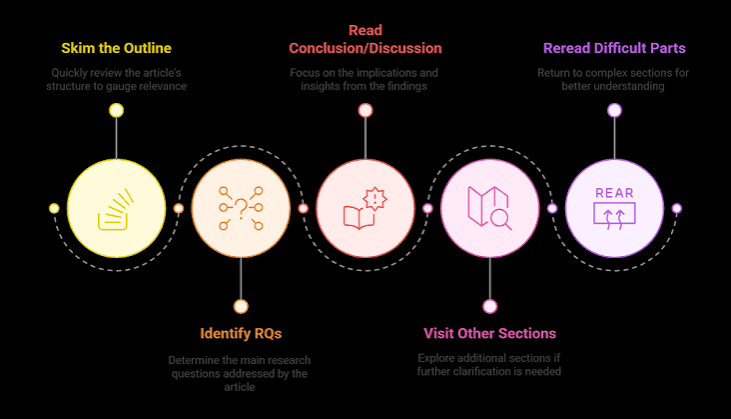
For many empirical research articles, a useful initial reading order is:
- Title and abstract
- Introduction
- Discussion and conclusion
- Results and figures
- Methods
- Full article review and references
This is a flexible strategy, not a universal rule. If your assignment focuses on research design, read the methods earlier. If you are analyzing a theoretical argument, concentrate on the central claims and supporting reasoning.
After previewing the paper, try to summarize its topic and main finding in one or two sentences. If you cannot do this, identify which section needs closer attention.
Step 4: Understand the Main Sections of an Academic Journal Article
Most empirical research articles contain several recognizable sections. Learning the purpose of each section makes complex papers easier to navigate.
Introduction: Why Was the Study Conducted?
The introduction explains the research problem and why it matters. It may discuss earlier studies, identify an unanswered question, present a hypothesis, or state the article’s objectives.
Look for the gap between what researchers already know and what the current study attempts to investigate.
Ask yourself:
- What problem are the authors addressing?
- What is already known about the subject?
- What remains uncertain?
- What is the main research question or hypothesis?
- Why might the study be important?
Do not assume that every statement in the introduction is a finding from the current study. Some information describes earlier research or provides background context.
Literature Review: What Do Previous Studies Say?
A literature review examines relevant research that has already been published. It helps explain how the current article fits into the broader academic discussion.
Pay attention to recurring findings, disagreements between researchers, important theories, and limitations in earlier studies.
When reading a literature review, distinguish between what the current authors have discovered and what they are reporting from previous publications.
Methods: How Was the Research Conducted?
The methods section explains how researchers collected and analyzed their evidence. Depending on the study, it may describe participants, sampling procedures, equipment, measurements, experiments, interviews, questionnaires, or statistical techniques.
This section is essential when evaluating whether the findings are trustworthy.
Consider these questions:
- Who or what was studied?
- How were participants, cases, or sources selected?
- How was the data collected?
- Were the measurements appropriate?
- How did the researchers analyze the evidence?
- Were ethical requirements addressed where relevant?
For example, a survey of 40 volunteers may provide useful information about those respondents, but it may not represent the views of an entire country’s student population.
You do not need to understand every technical detail on your first reading. Identify the overall research design, then investigate unfamiliar methods that are important to your assignment.
Results: What Did the Researchers Find?
The results section presents the evidence generated by the study. It may include numerical measurements, statistical tests, charts, tables, interview themes, observations, or other findings.
Focus first on the results that directly address the research question.
Ask:
- What were the main findings?
- Which results are supported by the presented data?
- Were any findings unexpected?
- Do the results answer the original research question?
- Are there important differences between groups or conditions?
Be careful not to confuse a result with its interpretation. A study may find an association between two variables, for instance, without establishing that one caused the other.
Discussion: What Do the Findings Mean?
The discussion explains how the authors interpret their results. Researchers may compare their findings with earlier studies, suggest possible explanations, describe practical implications, and identify limitations.
Read this section critically. The authors’ interpretation should be supported by the evidence presented in the results.
Notice whether the researchers consider alternative explanations and whether they acknowledge findings that do not fit their expectations.
Conclusion: What Is the Main Takeaway?
The conclusion summarizes the article’s contribution and explains what readers should take away from the research. It may also identify unanswered questions or suggest directions for future studies.
After reading it, ask whether the conclusion matches the methods and results. Strong conclusions remain within the limits of the available evidence.
References: Where Did the Evidence Come From?
The reference list identifies the sources cited in the article. It is useful for checking claims, locating original research, and discovering other publications on the same topic.
Look for relevant studies that appear repeatedly across papers. These may help you identify influential theories or important research in the field.
Step 5: Use Active Reading Techniques
Active reading means engaging with the paper instead of passively moving your eyes across the text. The aim is to understand, question, and remember the important information.
Annotate the Article
If you are reading a digital or printed copy, mark important passages and write brief notes in the margins or a separate document.
You might label passages as:
- Main claim: The central argument or finding.
- Evidence: Data or reasoning that supports a claim.
- Definition: An important concept or technical term.
- Question: Something you do not understand.
- Limitation: A weakness or restriction affecting interpretation.
- Connection: A link to another study or your assignment.
Avoid highlighting entire paragraphs. Select only the information that contributes to understanding the research question.
Summarize Each Section
After completing a section, pause and write a one- or two-sentence summary in your own words.
For example:
“The researchers compared students using two revision strategies. The results showed different average test scores, but the study design and sample need to be considered before drawing broad conclusions.”
A short summary helps you check your understanding and reduces the need to reread the entire article later.
Ask Questions While Reading
Use questions to guide your attention:
- What claim is being made?
- What evidence supports it?
- How was that evidence collected?
- What assumptions are involved?
- Are there other possible explanations?
- How does this relate to my research question?
These questions turn reading into a process of evaluation rather than simple information collection.
Step 6: Learn How to Read Academic Research Data
Many students find numerical results more difficult than the written sections. You do not necessarily need to understand every statistical calculation to identify the main findings, but you should know what the reported measurements mean.
Understand the Variables
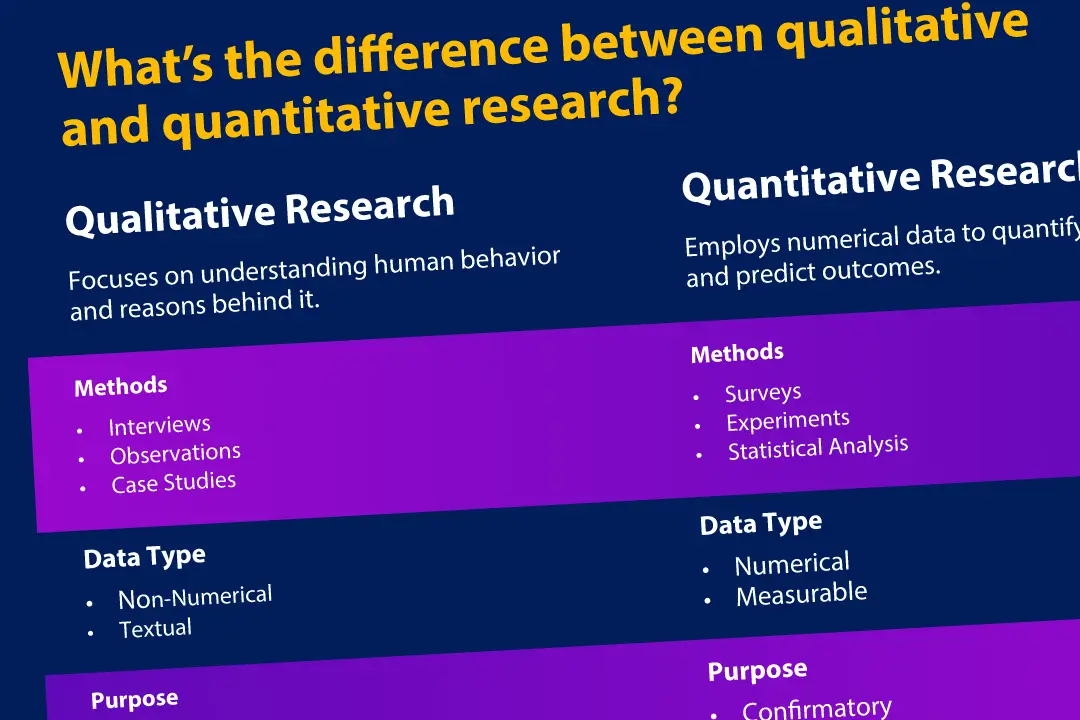
A variable is a characteristic that can differ between individuals, groups, or observations.
In a study of sleep and examination performance, sleep duration and exam scores might be measured as variables. Before interpreting the results, check how each variable was defined and measured.
Read Tables Carefully
When examining a table, check:
- The title and purpose of the table.
- The row and column headings.
- The units of measurement.
- The sample size, if reported.
- Any notes explaining abbreviations or statistical results.
Do not compare numbers until you understand what they represent and whether they use the same scale.
Interpret Charts and Graphs
Look at the axes, labels, legend, and scale. Identify the pattern the chart displays and compare it with the explanation in the article.
A graph can make a difference appear large or small depending on its scale, so avoid judging the importance of a result from appearance alone.
Understand Statistical Significance
In statistical research, a result described as statistically significant generally means that it meets a specified statistical criterion under the assumptions of the analysis.
It does not automatically mean the effect is large, practically important, or free from bias. Consider the effect size, uncertainty, study design, and relevance to the research question where these details are available.
Step 7: Evaluate the Quality and Reliability of the Article
Not every published paper provides equally strong evidence. Before relying on an article, assess the credibility of its publication, the quality of its methods, and the strength of its conclusions.
Check the Authors and Journal
Identify the authors and their relevant expertise. Examine the journal’s scope, editorial information, and peer-review practices where available.
Peer review can help improve scholarly work, but it does not guarantee that every finding is correct. Published research can contain errors, methodological weaknesses, or conclusions that later evidence challenges.
Examine the Research Design
Ask whether the methods are appropriate for the research question.
A well-designed experiment may support stronger causal conclusions than a simple observational study, depending on how the research was conducted. An interview study may be more appropriate for exploring experiences that cannot be adequately captured by numerical measurements.
Evaluate the study according to its purpose rather than expecting every article to use the same method.
Consider the Sample and Data
Check the sample size, participant selection, data collection procedures, and missing information.
A small sample is not automatically poor research, particularly in an in-depth qualitative study. However, the sample and method must be suitable for the conclusions being made.
Look for Limitations and Conflicts of Interest
Authors may discuss limitations such as restricted sample diversity, measurement problems, short study duration, or limited generalizability.
Also consider whether funding sources or potential conflicts of interest have been disclosed. Such disclosures do not automatically invalidate research, but they may be relevant when assessing the evidence.
Compare Important Claims With Other Research
When a claim is central to your assignment, check whether other credible studies report similar findings or identify conflicting evidence.
One article rarely settles a complex academic question on its own. Comparing research helps you understand how strong and consistent the evidence is.
Step 8: Understand Difficult Academic Vocabulary
Academic articles often contain specialized terminology, abbreviations, and complex sentences. These can make a paper seem more difficult than it actually is.
Use the following strategies to improve comprehension.
Identify key terms. Note words that appear repeatedly or seem central to the argument.
Use reliable definitions. Consult a subject textbook, academic glossary, or reputable reference source. Check how the term is used in the article’s specific field.
Break long sentences into parts. Identify the main subject, the action or claim, and the supporting details.
Rewrite complex ideas in plain English. Preserve the meaning while removing unnecessary technical wording.
Use context. Read the surrounding paragraph before deciding what an unfamiliar term means.
For example, “correlation” refers to a relationship between variables, while “causation” means that one factor produces or contributes to a change in another. Confusing these terms can lead to incorrect interpretations of research findings.
If a concept remains unclear, look for a textbook explanation or another scholarly article that introduces it more simply.
Step 9: Take Notes That Will Help With Assignments
Good research notes should help you remember what an article says, evaluate its usefulness, and cite it accurately later.
Instead of copying large sections of text, organize your notes around the information you need.
A practical article summary can include:
- Full citation: Authors, year, title, journal, and DOI or URL when available.
- Research question: What the study aimed to investigate.
- Method: How the researchers collected and analyzed evidence.
- Main findings: The most relevant results or arguments.
- Strengths and limitations: Factors affecting the quality or interpretation of the research.
- Relevance: How the article contributes to your assignment.
- Follow-up questions: Issues to investigate through additional reading.
Keep direct quotations clearly marked and record page numbers when available. When paraphrasing, use your own wording and cite the original source.
These habits reduce the risk of accidental plagiarism and make it easier to write a literature review later.
For more guidance, see our article on how to avoid plagiarism in academic writing.
Step 10: Connect the Article to Other Research
Academic understanding grows when you compare studies rather than treating each paper as an isolated source.
As you read multiple articles, look for similarities and differences in their research questions, methods, populations, and findings.
For example, two studies might examine whether spaced revision improves student performance. One may report improved test scores, while another finds a smaller effect. Differences in sample size, study duration, assessment design, or participant characteristics may help explain the results.
Create a comparison table to organize the evidence:
| Article | Research focus | Method | Main finding | Limitation |
|---|---|---|---|---|
| Study A | Revision frequency | Student survey | Frequent revision was associated with higher reported confidence | Self-reported data |
| Study B | Revision strategy | Controlled experiment | One strategy produced higher scores under the study conditions | Limited participant group |
| Study C | Long-term retention | Follow-up assessment | Retention differed across assessment periods | Short follow-up period |
This table is an illustrative example, not a summary of actual published studies. When building your own table, enter information taken directly from the articles you have read.
Comparing evidence in this way can help you identify research gaps, evaluate competing explanations, and organize a literature review around themes instead of writing a separate summary of every source.
Step 11: Avoid Common Academic Reading Mistakes
Even motivated students can struggle if they use an inefficient reading strategy.
Reading Every Article From Beginning to End Immediately
Reading every paper line by line can consume too much time when many sources are available. Preview articles first and reserve detailed reading for sources that are relevant to your question.
Relying Only on the Abstract
An abstract can omit important limitations and methodological details. Read the full article before making a detailed evaluation or relying on its findings for a major claim.
Accepting the Authors’ Conclusions Without Checking the Evidence
The discussion reflects the authors’ interpretation, but you should compare it with the results and methods. Ask whether the conclusions are justified by the data.
Highlighting Without Summarizing
Highlighting can help you locate information, but it does not prove that you understand it. Summarize key ideas in your own words and explain why they matter.
Ignoring Unfamiliar Terms
Repeatedly skipping important technical terms can lead to misunderstandings. Look up concepts that are essential to the research question or interpretation.
Taking Notes Without Recording Citations
Missing citation information can make it difficult to locate a source again. Record bibliographic details as soon as you decide an article is useful.
Treating One Study as Definitive Proof
Research findings should be interpreted in the context of study design, limitations, and the broader body of evidence. Look for corroborating research when the claim is important.
Step 12: Use a Practical Reading Plan for Each Article
A consistent routine can make academic reading more manageable. The following is an example of a 30-minute first-pass review for a moderately accessible article. Complex papers may require more time.
<text weight=”medium”>30-minute academic article reading plan</text>
| Time | Task | Goal |
|---|---|---|
| 0–3 minutes | Read the title, abstract, and keywords | Decide whether the article is relevant |
| 3–7 minutes | Preview headings, figures, and conclusion | Identify the structure and main message |
| 7–13 minutes | Read the introduction | Understand the question and background |
| 13–20 minutes | Examine results and relevant methods | Understand the evidence and how it was produced |
| 20–25 minutes | Read the discussion and limitations | Evaluate the interpretation |
| 25–30 minutes | Write a short summary and record the citation | Capture the main takeaway and next steps |
This plan is intended as a starting point, not a strict rule. If a paper is highly technical or central to your research, slow down and spend more time on the sections that matter most.
The goal is not to finish every article quickly. It is to understand the evidence efficiently and accurately.
A Simple Checklist for Reading Academic Journal Articles
Before using an article in an assignment, check that you can answer the following questions:
- What is the main research question or argument?
- Why was the study conducted?
- What methods or sources did the authors use?
- What are the most important findings?
- Does the evidence support the authors’ conclusions?
- What limitations affect the findings?
- How does the article relate to my research question?
- Do I have the full citation details?
- Do I understand the ideas well enough to summarize them in my own words?
- Do I need additional sources to verify or compare important claims?
If you cannot answer several of these questions, return to the relevant sections before relying on the article.
Frequently Asked Questions
What is the best way to read an academic journal article?
Start with the title, abstract, and keywords to assess relevance. Preview the introduction, discussion, conclusion, and figures before reading the methods and results carefully. Take notes, question the evidence, and summarize the main findings in your own words.
Should I read an academic article from beginning to end?
Not necessarily on your first pass. Previewing the article helps you determine which sections are most relevant. However, read the necessary sections in detail before evaluating the study or using its findings as important evidence.
How can I understand academic articles more easily?
Build familiarity with common research structures, look up essential technical terms, break complex sentences into smaller parts, and write brief summaries after each section. Comparing an unfamiliar paper with an introductory textbook or a clearer review article can also help.
How do I know if an academic journal article is reliable?
Evaluate the authors, journal, research methods, sample, data, limitations, and supporting references. Check for relevant disclosures and compare important claims with other credible research. Peer review is useful, but it does not guarantee that every finding is correct.
What should I write in my notes when reading a research paper?
Record the full citation, research question, method, main findings, limitations, and relevance to your assignment. Clearly mark direct quotations and distinguish the authors’ ideas from your own interpretations.
How many academic articles should I read for an assignment?
There is no single number that fits every assignment. The required amount depends on the subject, academic level, word count, and instructions. Focus on the quality, relevance, and coverage of your sources rather than choosing an arbitrary number.
What is the difference between a research article and a review article?
An original research article usually reports a study’s methods and findings. A review article synthesizes and evaluates existing research on a topic. A systematic review follows explicit procedures for identifying and selecting relevant studies, while other reviews may use different approaches.
How can I use academic journal articles without plagiarizing?
Understand the source before writing, express ideas genuinely in your own words, and cite the original publication. Use quotation marks for direct quotations and record page numbers when available. Follow your institution’s citation and academic integrity rules.
Conclusion
Learning how to read academic journal articles is an essential skill for students who want to research effectively, write stronger assignments, and develop independent critical thinking. The process becomes easier when you read with a purpose, preview the article, understand its main sections, evaluate the evidence, and record useful notes.
Remember that reading a research paper is not simply about extracting its conclusion. You also need to understand how the researchers reached that conclusion, what limitations affect the findings, and how the study fits into the wider academic discussion.
With regular practice, you can become more confident at interpreting technical language, recognizing strong evidence, and comparing different perspectives. These skills will help you make better use of scholarly sources throughout your academic journey.