Choosing the right research method is one of the most important decisions students make when planning an academic project. Some research questions require numerical data and statistical analysis, while others need detailed explanations of people’s experiences, opinions, or behavior. Understanding the difference between qualitative and quantitative research helps you select an approach that fits your research question and produces meaningful results.
The debate around qualitative vs quantitative research is not about deciding which method is universally better. Both approaches are valuable, but they serve different purposes. Qualitative research explores meanings and experiences, while quantitative research measures variables and examines numerical patterns. In some projects, researchers combine both approaches to develop a more complete understanding of a topic.
In this guide, you will learn what qualitative and quantitative research mean, how their methods differ, when to use each approach, and how to choose the right method for your academic assignment.
What Is Qualitative Research?
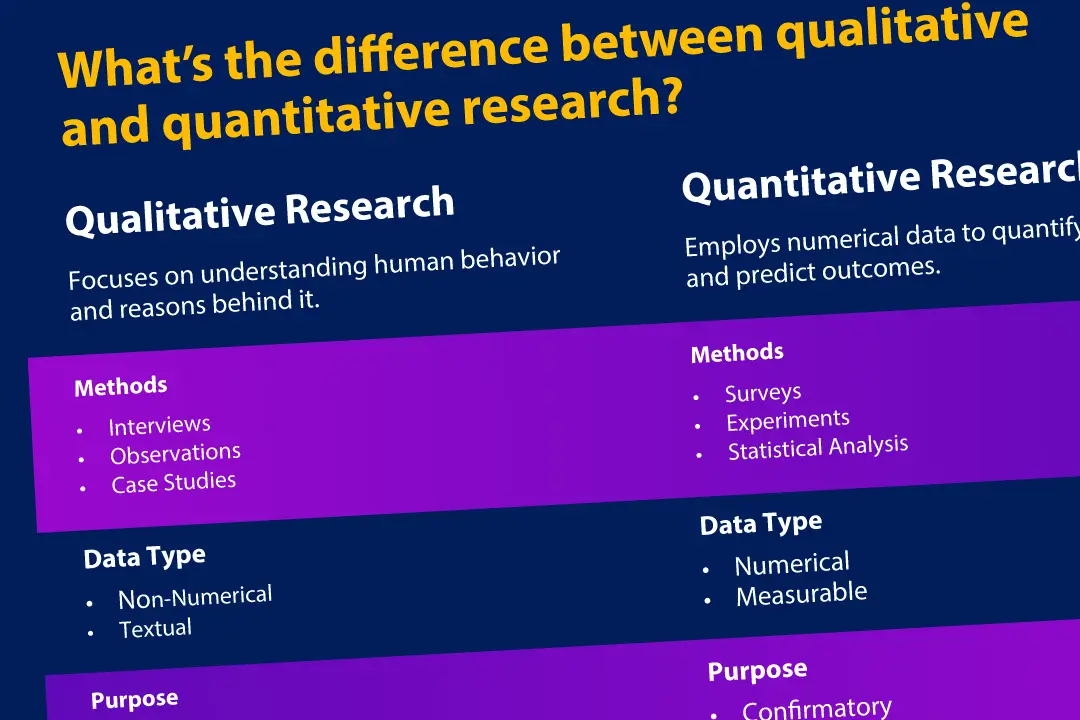
Qualitative research is an approach used to understand experiences, perspectives, behaviors, and social processes in depth. It focuses primarily on non-numerical information, such as interview transcripts, written responses, observations, documents, and descriptions of real-world situations.
Rather than asking only how many people experience something, qualitative researchers often investigate why people think, feel, or behave in particular ways.
For example, a researcher studying online education might interview university students to understand what makes virtual classes engaging or frustrating. Their responses could reveal issues involving internet access, teaching styles, motivation, or communication with instructors.
Common Qualitative Research Methods
Interviews: Researchers ask participants open-ended questions to explore their experiences, opinions, or interpretations.
Focus groups: A small group discusses a topic while a researcher examines shared views, disagreements, and interactions.
Observations: Researchers observe behavior or activities in a particular setting, sometimes participating in the environment being studied.
Case studies: Researchers examine a person, organization, event, or situation in detail to understand its context and complexity.
Document analysis: Researchers analyze written materials, reports, diaries, policies, or other documents to identify meanings and recurring themes.
These methods allow researchers to investigate complex questions that may not be adequately explained through numerical measurements alone.
Characteristics of Qualitative Research
Qualitative research commonly has the following characteristics:
- It explores meanings, experiences, and perspectives.
- It often uses open-ended questions.
- It produces detailed descriptions rather than primarily numerical results.
- It considers the context in which behavior or experiences occur.
- It commonly analyzes data by identifying themes, patterns, and interpretations.
- It may use flexible research questions that develop as understanding grows.
Qualitative studies can provide rich insights, but their findings should be interpreted in relation to the participants, setting, and research design. A small group of interviewees, for example, cannot automatically represent the views of an entire population.
What Is Quantitative Research?
Quantitative research uses numerical data to measure variables, describe patterns, compare groups, and investigate relationships. Researchers collect information in a structured format and analyze it using mathematical or statistical techniques.
This approach is useful when a research question involves quantities, frequencies, differences, or measurable outcomes.
For example, a researcher investigating student attendance might collect attendance records from several classes and examine whether attendance rates are associated with examination results. The analysis could reveal a relationship between the variables, although it would not automatically establish that attendance caused the differences in results.
Common Quantitative Research Methods
Surveys with structured questions: Researchers collect standardized responses, often using multiple-choice questions, rating scales, or other predefined answer formats.
Experiments: Researchers manipulate one or more variables under controlled conditions to examine their effects, where the design permits such conclusions.
Structured observations: Researchers record predefined behaviors or events using consistent categories and measurement rules.
Existing numerical datasets: Researchers analyze previously collected statistics, administrative records, or publicly available datasets.
Correlational studies: Researchers examine whether variables change together without necessarily manipulating them.
The appropriate method depends on the research question, available data, ethical requirements, and the conclusions the study is intended to support.
Characteristics of Quantitative Research
Quantitative research often includes these features:
- It focuses on measurable variables.
- It uses structured data collection procedures.
- It produces numerical results.
- It applies statistical or mathematical analysis.
- It may test hypotheses or estimate relationships between variables.
- It can estimate population patterns when sampling and measurement are appropriate.
Quantitative research can support comparisons and statistical generalizations, but the quality of its conclusions depends on factors such as sampling, measurement accuracy, study design, and the suitability of the statistical analysis.
Qualitative vs Quantitative Research: Key Differences
The main difference between qualitative and quantitative research is the type of question each approach is designed to answer and the evidence used to answer it.
| Feature | Qualitative Research | Quantitative Research |
|---|---|---|
| Main purpose | Understand experiences, meanings, and processes | Measure variables, patterns, and relationships |
| Data type | Primarily non-numerical | Primarily numerical |
| Typical questions | How? Why? What does it mean? | How many? How much? How often? |
| Common methods | Interviews, focus groups, observations, document analysis | Structured surveys, experiments, numerical datasets |
| Sample selection | Often purposive or based on relevant experience | Often structured to support comparison or statistical inference |
| Analysis | Themes, patterns, interpretations | Statistical calculations, comparisons, models |
| Typical results | Detailed descriptions and contextual insights | Numerical summaries, estimates, and statistical relationships |
| Research design | May be flexible and develop during the study | Often specifies measurements and procedures in advance |
| Strength | Explains complexity and context | Measures patterns and supports numerical comparisons |
| Common limitation | Findings may not transfer to other settings without careful assessment | Numerical results may overlook context or depend on imperfect measurements |
These are general tendencies, not absolute rules. Qualitative researchers can count themes, quantitative researchers can use written responses that are coded into numerical categories, and some studies combine both types of evidence.
Examples of Qualitative and Quantitative Research
Looking at practical examples makes the difference easier to understand.
Example 1: Student Satisfaction With Online Learning
Qualitative approach: Interview students about their experiences with online classes. Analyze their responses to identify themes such as flexibility, isolation, technical difficulties, and instructor support.
Quantitative approach: Ask students to rate their satisfaction on a five-point scale. Calculate average ratings and compare responses across groups.
The qualitative approach helps explain what students value or struggle with. The quantitative approach shows how satisfaction ratings are distributed and whether measurable differences appear between groups.
Example 2: Study Habits and Examination Performance
Qualitative approach: Conduct interviews to explore how students plan revision sessions, manage distractions, and respond to exam pressure.
Quantitative approach: Collect information about study hours and examination scores, then examine whether the variables are associated.
The numerical approach can identify a relationship, but additional evidence is needed to determine whether more study time causes higher scores. The qualitative approach can help explain students’ strategies and the circumstances influencing their study habits.
Example 3: Classroom Participation
Qualitative approach: Observe classroom discussions and interview students about what encourages or discourages them from speaking.
Quantitative approach: Record the number of times students contribute during lessons and compare participation rates across defined conditions.
Combining these methods could help researchers measure participation and understand the reasons behind it.
Example 4: Public Health Awareness
Qualitative approach: Interview community members about their understanding of a health campaign and the barriers they face when following its recommendations.
Quantitative approach: Survey a larger group to measure awareness levels or estimate the proportion of people who recognize particular recommendations.
The choice depends on whether the primary objective is to understand people’s perspectives, estimate the prevalence of awareness, or address both questions.
Advantages of Qualitative Research
Qualitative research offers several important benefits, especially when studying complex human experiences or topics that are not easily reduced to numbers.
1. Provides In-Depth Understanding
Open-ended questions allow participants to explain their experiences in their own words. Researchers can investigate details that a fixed-response questionnaire might miss.
2. Explores Context and Meaning
Human behavior is influenced by social, cultural, institutional, and personal circumstances. Qualitative research can examine these influences in detail.
3. Identifies Unexpected Insights
Participants may raise issues that researchers did not anticipate. These insights can help refine research questions and suggest areas for further investigation.
4. Supports Exploratory Research
When little is known about a subject, qualitative methods can help researchers develop concepts, identify relevant factors, and formulate questions for future studies.
Limitations of Qualitative Research
Qualitative research also has limitations. Collecting and analyzing detailed interviews or observations can take considerable time. Interpretation requires careful judgment, and researchers must consider how their own assumptions may influence the analysis.
Because qualitative studies often focus on specific participants or settings, their findings do not automatically apply to wider populations. Researchers should explain the study context and provide enough evidence for readers to assess whether the insights may be relevant elsewhere.
Advantages of Quantitative Research
Quantitative research is particularly useful when a study needs to measure variables consistently, compare groups, or examine numerical patterns.
1. Enables Clear Numerical Comparisons
Researchers can compare averages, percentages, rates, and other measurements across groups, time periods, or conditions.
2. Supports Statistical Analysis
Appropriate statistical methods can help estimate relationships, evaluate differences, quantify uncertainty, and test hypotheses.
3. Can Examine Larger Populations
When a study uses suitable sampling and measurement procedures, quantitative methods can support estimates about a broader population.
4. Improves Measurement Consistency
Structured instruments and predefined procedures can help researchers collect comparable data across participants or settings.
Limitations of Quantitative Research
Quantitative research can overlook important experiences if the chosen measurements do not capture the full complexity of a topic. A survey may reveal that students report low motivation, for instance, without explaining the underlying reasons.
Results can also be misleading when survey questions are poorly designed, measurements are inaccurate, samples are biased, or statistical methods are inappropriate. Numerical precision does not guarantee that a study’s conclusions are valid.
When Should You Use Qualitative Research?
Qualitative research is often a suitable choice when your main goal is to explore experiences, understand perspectives, investigate processes, or develop an in-depth explanation.
Consider a qualitative approach when:
- You want to understand why people behave in a particular way.
- Your research question focuses on personal experiences or interpretations.
- The topic is complex or not well understood.
- You need detailed descriptions of a specific situation.
- You want to explore possible explanations before designing a larger study.
- Your evidence will primarily come from interviews, observations, or documents.
For example, if you want to understand why first-year university students feel anxious about participating in class, interviews may reveal concerns that a rating scale alone would not explain.
Qualitative research is not limited to small projects, and it is not automatically easier than quantitative research. Designing effective interviews, handling data responsibly, and analyzing themes systematically require careful planning.
When Should You Use Quantitative Research?
Quantitative research is often appropriate when you need to measure something, compare defined groups, estimate frequencies, or examine relationships between variables.
Consider a quantitative approach when:
- Your research question asks how many, how much, or how often.
- You need to compare measurable outcomes.
- You want to test a clearly defined hypothesis.
- You have access to suitable numerical data.
- You need to estimate a population characteristic using an appropriate sample.
- You want to measure changes across time or conditions.
For example, if you want to estimate how frequently students use digital learning platforms, a structured survey may provide more useful evidence than a series of open-ended interviews.
Before selecting a quantitative design, ensure that your variables can be measured meaningfully and that the data collection process fits the question you want to answer.
What Is Mixed-Methods Research?
Mixed-methods research combines qualitative and quantitative approaches within a single study or coordinated research program. Researchers use it when numerical measurements and detailed explanations can contribute different but complementary insights.
For example, a university may investigate student satisfaction with a new learning platform using two methods:
- Distribute a structured survey to measure satisfaction across a broad group of students.
- Interview selected students to explore the reasons behind their ratings.
The survey identifies patterns, while the interviews help explain the experiences behind those patterns.
Common Mixed-Methods Designs
Explanatory sequential design: Researchers collect and analyze quantitative data first, then use qualitative research to help explain the results.
Exploratory sequential design: Researchers begin with qualitative exploration and use what they learn to develop a questionnaire, measurement instrument, or later quantitative study.
Convergent design: Researchers collect qualitative and quantitative data during a similar period and compare or integrate the findings.
Mixed-methods research can provide a more comprehensive understanding, but it requires a clear plan for combining the results. Simply collecting numbers and interviews does not automatically make a study effective. The two forms of evidence should contribute to answering the research question.
How to Choose the Right Research Method for Your Project
If you are unsure which approach to use, begin with the research question rather than your preferred data collection method.
Step 1: Identify Your Main Objective
Decide whether you primarily want to explore experiences, measure a pattern, test a relationship, or answer several types of questions.
Your objective should determine the method, not the other way around.
Step 2: Examine the Type of Evidence You Need
Ask what information would provide a convincing answer.
If you need detailed explanations of participants’ experiences, interviews may be suitable. If you need to estimate how common a behavior is, a structured survey may be more appropriate.
Step 3: Consider Your Resources
Evaluate the time, budget, skills, equipment, source access, and participant access available to you. A method that is theoretically suitable may not be practical for your assignment.
Choose a manageable design that can still produce credible evidence.
Step 4: Review Ethical Requirements
Research involving people may require informed consent, confidentiality protections, institutional permission, or formal ethical review. Your responsibilities depend on the project and your institution’s rules.
Select a method that you can carry out ethically and responsibly.
Step 5: Check the Requirements of Your Assignment
Your instructor may specify a research design, required data sources, minimum sample size, or analysis technique. Confirm these requirements before collecting data.
Step 6: Make Sure Your Analysis Fits Your Question
Think about how you will analyze the evidence before collecting it. If you plan to use numerical measurements, determine which calculations are appropriate. If you plan to use interviews, decide how you will organize and interpret the responses.
Planning analysis early helps you avoid collecting information that cannot answer your research question.
For further guidance, see our article on
Common Misconceptions About Qualitative and Quantitative Research
Several misunderstandings can lead students to choose an unsuitable method or interpret findings incorrectly.
Misconception 1: Quantitative Research Is Always More Scientific
Numerical data can support rigorous analysis, but quality depends on the research design, measurements, sampling, and interpretation. A poorly designed survey can produce misleading results just as a poorly conducted interview study can.
Misconception 2: Qualitative Research Is Just Personal Opinion
Qualitative research uses systematic procedures for collecting, organizing, and analyzing evidence. Researchers should explain their methods, support interpretations with data, and consider alternative explanations.
Misconception 3: Qualitative Research Cannot Include Numbers
Qualitative studies may count themes, compare the frequency of ideas, or include descriptive statistics. However, the central purpose remains understanding meanings, experiences, or processes rather than primarily measuring variables.
Misconception 4: Quantitative Research Always Requires a Large Sample
Sample size depends on the research question, design, variability, intended analysis, and desired precision. Some quantitative studies use small samples, although their conclusions may be limited. Researchers should justify sample size rather than assume that bigger is always better.
Misconception 5: Mixed Methods Are Always the Best Choice
Combining methods can be useful, but it adds complexity and requires sufficient time and expertise. A well-designed qualitative or quantitative study may be more appropriate when it fully addresses the research question.
How to Improve the Quality of Your Research
Regardless of which method you choose, certain practices help make research more credible and useful.
- Use a clear research question: A focused question guides every stage of the project.
- Choose suitable methods: Make sure your data collection approach matches your objectives.
- Use credible sources: Evaluate academic articles, reports, datasets, and other evidence carefully.
- Document your procedures: Record how you selected sources, recruited participants, collected data, and analyzed findings.
- Consider bias: Think about how sampling, wording, researcher expectations, or missing data might affect the results.
- Protect participants: Follow applicable privacy, consent, and ethical requirements.
- Acknowledge limitations: Explain what your design can and cannot establish.
- Keep conclusions evidence-based: Do not make stronger claims than the data supports.
- Revise your report: Check clarity, structure, accuracy, and referencing before submission.
These practices are important for school assignments, undergraduate research, graduate projects, and professional investigations.
Frequently Asked Questions
What is the main difference between qualitative and quantitative research?
Qualitative research primarily explores experiences, meanings, and processes using detailed non-numerical evidence. Quantitative research primarily measures variables and examines numerical patterns using statistical or mathematical analysis. The appropriate approach depends on the research question.
Which is better, qualitative or quantitative research?
Neither approach is universally better. Qualitative research is useful for understanding experiences and context, while quantitative research is useful for measurement, numerical comparison, and statistical analysis. The best method is the one that fits your objectives and available evidence.
Can a research project use both qualitative and quantitative methods?
Yes. Mixed-methods research combines both approaches to answer complementary questions. For example, a researcher may use a survey to measure student satisfaction and interviews to understand why students gave particular ratings.
What are examples of qualitative research?
Examples include interviewing students about their classroom experiences, observing how people interact in a workplace, analyzing personal narratives, and examining how communities interpret a social issue.
What are examples of quantitative research?
Examples include measuring exam scores, surveying how frequently students use a learning platform, comparing average results between groups, and analyzing numerical trends in public datasets.
Is a questionnaire qualitative or quantitative research?
It depends on the questions and how the responses are analyzed. A questionnaire with fixed response options or rating scales is often quantitative. A questionnaire with open-ended questions can generate qualitative data. A questionnaire containing both may support a mixed-methods design.
What is the difference between qualitative and quantitative data?
Qualitative data generally describes experiences, meanings, categories, or observations using words and other non-numerical forms. Quantitative data represents quantities or measurements that can be expressed numerically. The way information is collected and analyzed determines how it is used in a study.
Can qualitative research prove cause and effect?
Qualitative research can help explain processes and suggest possible causal mechanisms, especially when evidence is collected carefully over time and across relevant contexts. However, causal claims require a research design and evidence suited to evaluating alternative explanations. No single method automatically guarantees a causal conclusion.
Conclusion
Understanding qualitative vs quantitative research helps students choose a method that fits their academic objectives. Qualitative research offers detailed insight into people’s experiences, meanings, and behavior, while quantitative research measures variables and examines numerical patterns. Mixed-methods research combines both when a question benefits from complementary forms of evidence.
Before choosing an approach, define your research question, identify the evidence needed to answer it, consider your available resources, and review any ethical or assignment requirements. Then select methods that allow you to collect and analyze relevant information systematically.
The most effective research is not necessarily the most complicated. It is research that asks a clear question, uses appropriate evidence, acknowledges limitations, and draws conclusions that the findings can genuinely support.
Leave a Reply